
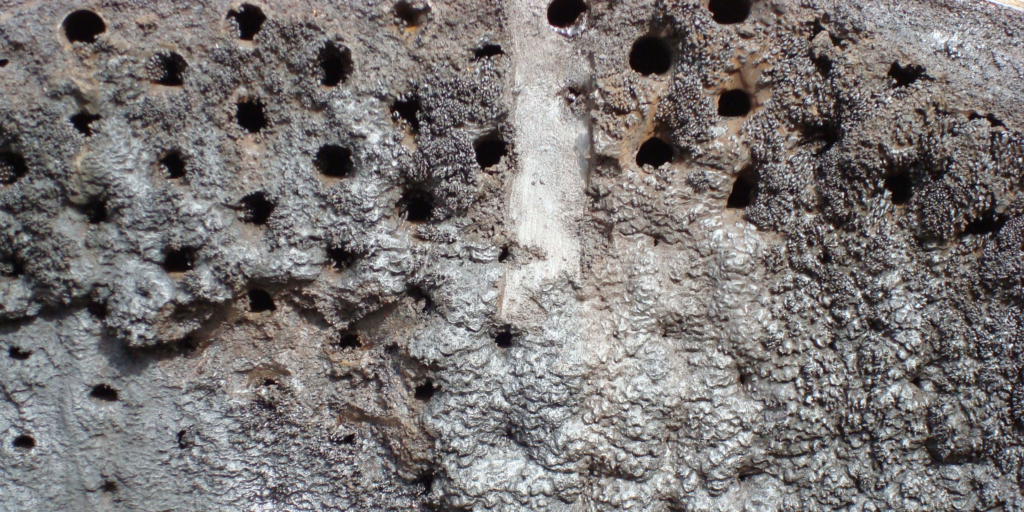
Polymer fouling is not a standard cleaning problem. At petrochemical plants and plastics facilities, HDPE, LDPE, and LLDPE deposits don’t just accumulate on tube walls — they bond chemically to the metal surface. Over time, they harden. They shrink the bore. And when production pressure keeps running, they build layer after layer until some tubes are fully plugged.
Most facilities respond the way they always have: call a hydroblasting contractor. High-pressure water jets. 20,000 PSI. Sometimes 40,000 PSI. The crew works for days. The tubes come back marginally cleaner. Three weeks later, production efficiency has already started to drop again.
If that pattern sounds familiar, it is not a contractor problem. It is a physics problem.
Conventional hydroblasting was not designed for polymer fouling. Applying extreme water pressure to a bonded polymer deposit does not remove the fouling — it compresses it, partially dislodges it, and leaves behind a residual layer that re-accumulates faster than it would have on clean metal. The result is shorter run cycles, repeated cleaning costs, and a turnaround schedule that never improves.
This article explains exactly why hydroblasting underperforms on polymer fouling — and what a different approach looks like in practice.
What makes polymer fouling different from other deposits
What Makes Polymer Fouling Different from Other Deposits
Scale, coke, and mineral deposits sit on metal surfaces. They form through precipitation or thermal decomposition, and their bond to the tube wall is primarily mechanical. Apply enough pressure or physical force and they fracture.
Polymer fouling is different in a fundamental way. Polyethylene and polypropylene deposits form an adhesive bond with the tube wall. The polymer chains entangle with microscopic surface irregularities in the metal. As the deposit ages and thermal cycling continues, it crosslinks and densifies. What started as a soft residue becomes a hard, rubbery or glassy layer that is chemically and mechanically attached to the tube.
Key characteristics that set polymer fouling apart:
- Adhesive bonding: polymer deposits attach to tube walls at the molecular level, not just resting on the surface
- Elasticity under pressure: hardened polymer can flex under high-pressure water impact and partially recover its shape after the water stream passes
- Layered accumulation: each operating cycle adds another layer on top of the last, compressing earlier deposits further
- Resistance to shear: a water jet traveling axially down a tube creates shear force, which polymer deposits resist more effectively than brittle scale
None of these characteristics are addressed by adding more pressure to a water jet. The fundamental cleaning mechanism — hydraulic shear — is not the right tool for a bonded adhesive deposit.
Why high-pressure hydroblasting falls short
Conventional hydroblasting delivers results through kinetic energy. A high-velocity water stream impacts fouling, chips it loose, and carries it out of the tube. This works well for brittle, non-adhesive deposits. For polymer fouling, the mechanism fails at several points.
The pressure ceiling problem
Increasing pressure to 40,000 or even 60,000 PSI eventually risks tube damage before it achieves full polymer removal. Thin-wall tubing and titanium tubes are especially vulnerable. Operators face a practical limit: the pressure required to mechanically strip a bonded polymer deposit may exceed the safe operating envelope for the equipment being cleaned.
Partial cleaning creates a rougher surface
When high-pressure water partially removes a polymer deposit, it leaves behind a roughened residual layer. That texture gives the next operating cycle more surface area for adhesion. Subsequent fouling builds faster on a partially cleaned tube than it would on a properly cleaned one. Facilities that rely on conventional hydroblasting often report production run cycles getting shorter over successive turnarounds.
Fully plugged tubes stop the process entirely
Once polymer fouling has completely blocked a tube, a water jet has nowhere to go. Conventional hydroblasting requires flow path to work. A 100% blocked tube cannot be cleaned from the inlet — the jet dead-ends on the plug. The standard response at this point is to declare the tube uncleanable and plug it, pulling the exchanger offline until bundle replacement is authorized.
The cost of getting the cleaning wrong
For turnaround managers and reliability engineers, the cleaning contractor invoice is not the actual cost of a failed polymer fouling removal. The real cost shows up elsewhere.
Shortened production runs
One petrochemical recovery unit in Houston was running 6 to 8-week production cycles before fouling forced a shutdown. The facility was spending $30,000 per clean and turning equipment back over within two months. That frequency alone represents a significant annual maintenance cost — before accounting for lost production during each shutdown.
Bundle replacement costs
A Texas City facility had a 600-tube exchanger blocked for over a decade. Multiple drilling attempts left nine drill bits inside the tubes. The plant had already ordered a replacement unit at a cost of $500,000. The exchanger was cleaned in five hours. The replacement was cancelled.
Extended turnaround duration
When cleaning takes longer than planned, the entire turnaround extends. At a major LDPE plant, cleaning an interstage cooler previously required removing 56 short-radius elbows, building scaffolding, and an 8-day shutdown. Hydrokinetic cleaning navigated through the bends without disassembly and cut the shutdown to 4 days — removing the exchanger from the critical path entirely.
These are not edge cases. They are the predictable outcomes of applying the wrong cleaning technology to a problem it cannot solve.
What hydrokinetic cleaning does differently
Hydrokinetic cleaning uses a different mechanism to address polymer fouling. Rather than relying solely on hydraulic impact force, the process introduces sonic resonance into the water stream. The sonic energy travels through the water column and transfers to both the tube wall and the polymer deposit simultaneously.
Because the tube metal and the polymer deposit have different physical compositions, they resonate at different frequencies. That differential vibration breaks the adhesive bond between the deposit and the tube wall at the interface — the one place conventional hydroblasting cannot reach. Once the bond is broken, the loosened fouling material is expelled from the tube by the water flow.
How this changes the cleaning outcome:
- Fully plugged tubes can be cleaned: sonic resonance works through the deposit without requiring an open flow path from the start
- No tube damage: operating pressure is lower than conventional ultra-high-pressure hydroblasting, safe for thin-wall and titanium tubes
- Complete removal at the interface: the bond breaks before the deposit is expelled, not after, leaving a cleaner metal surface
- Faster results: the process runs 40 to 50 percent faster than conventional hydroblasting on the same equipment
- No chemicals required: the process uses only pressurized water and sonic energy
The equipment operates remotely with a simplified control console. The technician works at a safe distance from the tube sheet, reducing fatigue and maintaining consistent technique throughout the clean.
Results in polymer fouling applications
The difference between a hydroblasting solution that partially cleans and one that solves the problem is measurable in production cycles, shutdown duration, and maintenance cost. Here is what that looks like across documented Hydrokinetics projects.
14-exchanger polymer recovery unit, Houston, TX
Seven thousand tubes across 14 exchangers. Some plugged or lined with polymer for years. Conventional hydroblasting cost $30,000 per cleaning cycle and delivered 6 to 8-week production runs. After Hydrokinetic cleaning, production runs extended to 3 months or more with little drop in efficiency.
HDPE vertical exchanger — 4,700 tubes, one-week window
Thirty-five percent of tubes fully plugged with heavy residual polymer scale. No contractor had previously cleaned this exchanger to near design efficiency within the available turnaround window. Three units deployed simultaneously, running 24 hours. All 4,700 tubes cleaned in less than 3 shifts against a proposed 13-shift scope.
Ethane cracker heat exchangers — five failed contractors
Five contractors attempted the same exchangers with conventional hydroblasting up to 20,000 PSI. None cleaned a single unit to MFL inspection level. Hydrokinetics cleaned the first exchanger in a single pass in less than two shifts. The client awarded the remaining 15 exchangers and a long-term annual contract.
Frequently Asked Questions from turnaround managers
Can you clean tubes that are 100% blocked with polymer?
Yes. Fully plugged tubes are the most common reason facilities call us. Sonic resonance does not require an open flow path to begin breaking the bond. We have cleaned tubes blocked with polymer, crystallized coke, calcium scale, and rock-hard conglomerate.
Other contractors already tried and failed. Is it worth calling?
Yes. Most of the projects in our case history started with failed conventional attempts. The cleaning mechanism is fundamentally different, not just higher-pressure or better-equipped. Call 409-945-5414 and describe what you are dealing with.
Will it damage our thin-wall or titanium tubes?
No. We have cleaned thin-walled and titanium tubes without surface damage. Because the cleaning mechanism targets the bond interface rather than relying on abrasive impact, operating pressure is lower than ultra-high-pressure hydroblasting.
How much faster is this compared to conventional hydroblasting?
40 to 50 percent faster on comparable equipment. On the HDPE vertical exchanger described above, the scope was completed in 3 shifts against a 13-shift proposal. On the LDPE interstage cooler, shutdown duration dropped from 8 days to 4 days.
The right tool for polymer fouling
Polymer fouling does not respond to more pressure. It responds to a different mechanism — one that addresses the adhesive bond rather than trying to hammer through it.
If your facility is cycling through cleaning contractors, seeing production runs get shorter after each turnaround, or facing exchangers that other contractors have declared uncleanable, the issue is not execution. It is approach.
Hydrokinetics has been solving polymer fouling problems at petrochemical plants, HDPE and LDPE facilities, and ethane crackers for more than 20 years, across 12 countries. Three patents. No recordable incidents.
If you are planning a turnaround or dealing with an exchanger that is not performing, call our hydrokinetics team at 409-945-5414.
